
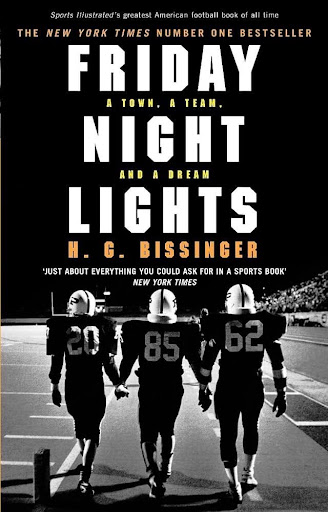
Football is one of the most popular sports in America, and even journalist H.G. Bissinger could not resist its allure, dedicating his first book, Friday Night Lights, to it. Traveling to the barren town of Odessa, Texas, he documented Permian High School’s football team, the Permian Panthers, during their ‘88 season. After publication, he faced a swarm of seething Odessans, for the town found out he wrote an expose detailing the rampant corruption within their beloved football team; Bissinger’s gutsy declaration is what makes the book invaluable. Using opinion, history, and objectivity, he crafted a literary piece that critiques football’s societal influence.
The book’s plot advances through the Panthers’ games, until they play against the Carter Cowboys during the playoffs, where the story concludes. Bissinger shines in writing the time between games, where he elaborates on Odessa’s history and its deadly obsession with football, shown through abuse towards football players and citizens alike. Bissinger’s colorful figurative language is his only tactic to persuade the audience of football’s negativities: he mainly portrays objective evidence and documents the opinion of citizens to create a nuanced portrayal of football. His interviews even extend to abusers in Odessa, who are all connected to football, portraying that football’s influence on the community, rather than the physical sport, has created Odessa’s corruption. He even travels back to Odessa years later in an epilogue to interview past football players, which proves football’s detrimental effects: originally treated as gods in their youth, the players have grown into depressed men that push their sons into the same sport that ruined them. At the main story’s conclusion, Bissinger implores the nation of America to reconsider how much it should allow football to influence the country. When he later revisits this idea in the epilogue and describes how nothing has been done to mitigate football’s impacts, he leaves the audience inspired to try and make a change within their own community. The reactions his words created serve as a testament to how effective he is as an author, and Friday Night Lights is a wonderful endeavor to change an entrenched societal issue.
While the book’s message is impeccable, Bissinger’s execution is lacking in two minor aspects. Firstly, he assumes the audience understands the technicalities of a football game, making it confusing to follow without adequate background knowledge. Secondly, some of his context is so extensive it becomes convoluted, requiring the audience to re-read multiple sections of his text.
Though a commitment to read, Friday Night Lights is a great book that exposes the toxic mindset of football that is still applicable to modern day.

